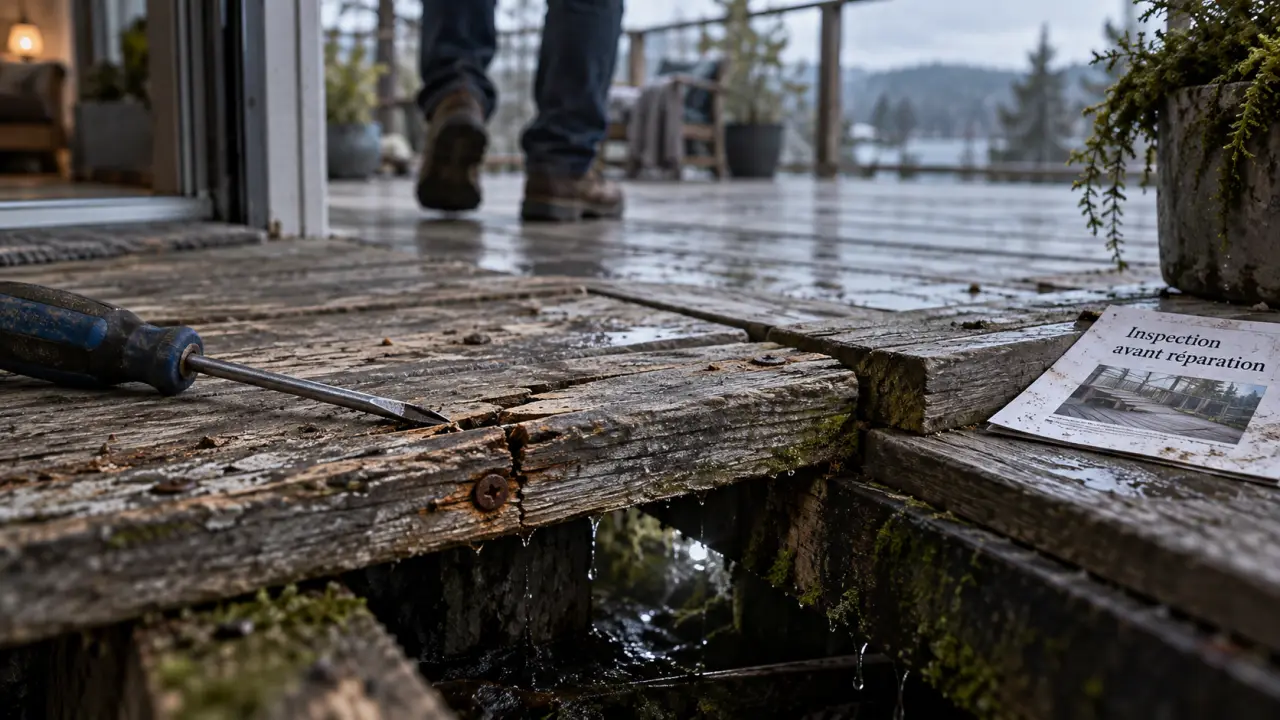
Repairing a deck starts with one question: is the problem limited to the surface, or has it reached the structure underneath? A faded finish and a few loose boards are usually manageable. A bouncy floor, rotted framing, or unstable railing is different. Before buying stain, screws, or replacement boards, inspect the deck from top to bottom and let safety come first.
Start with a safety check, not the appearance
Walk slowly across the deck and note any movement underfoot. Look closely at the boards, railings, stairs, and the connections where the deck meets the house. Surface wear can look dramatic while the frame remains sound. The opposite can also happen: an attractive deck may hide serious decay below.
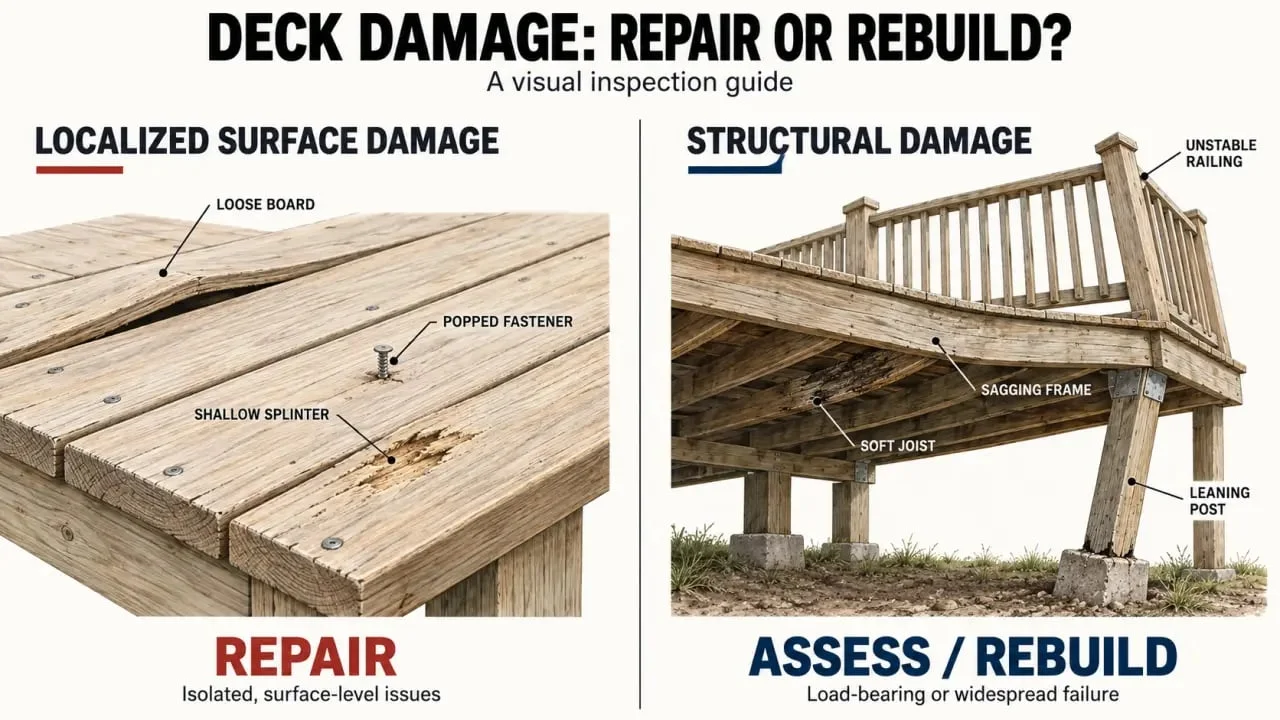
Signs that usually suit a repair
Localized problems are often repairable: a handful of cracked or warped deck boards, popped nails, loose screws, small splinters, faded stain, or a gap that needs sealant. Press a screwdriver into suspicious areas, especially at board ends, around fasteners, and near posts. Firm wood generally supports a targeted repair. Soft, spongy wood that crumbles easily does not.
Signs that should stop a DIY repair
A sagging deck, leaning posts, wobbly railings, loose stair stringers, widespread rot, insect damage, or missing fasteners can affect the deck’s structural integrity. Replacing the visible board may not solve the underlying problem. If joists, beams, ledger connections, or post bases are deteriorated, arrange a professional assessment before using the deck again. This matters even more when the deck is elevated or attached to the home.
Find out whether the damage is isolated or spreading
The decision to repair or replace becomes clearer when you map the damage instead of focusing only on the worst-looking spot. Check the underside with a flashlight if access allows. Pay attention to areas that stay damp, including the space beside the house, the area under planters, spots near downspouts, and gaps where leaves collect between boards.
Moisture damage can spread through adjoining components without being obvious from above. One soft board may simply need replacing. Several soft boards above the same joists can point to trapped water and decay in the framing. That pattern is the useful clue: repair the water problem as well as the damaged material, or the new boards may fail for the same reason.
| What you find | Likely response | What to check next |
|---|---|---|
| Loose screws or nails | Tighten or replace fasteners | Confirm that boards are not split or rotten around the holes |
| One or two damaged boards | Replace the individual boards | Inspect the joists directly below |
| Fading, stains, or shallow splinters | Clean, sand where appropriate, then stain or seal | Make sure the wood is dry first |
| Several soft areas, sagging, or unstable rails | Arrange a professional structural inspection | Assess the beams, joists, posts, and connections |
Choose the repair that matches the real problem
Fasteners, boards, and minor gaps
When the framing is sound, replace corroded or missing fasteners and secure loose boards. Remove a failed board carefully so adjacent boards are not damaged, then inspect the joist surface before fitting the new one. Small, non-structural gaps may be filled with polyurethane sealant where appropriate, but sealant cannot replace decayed wood.
Recessed nail heads, repeated splitting, and enlarged fastener holes often justify installing a new board instead of attempting another quick fix. If the new fastener cannot hold firmly in the wood, the problem is no longer limited to the hardware.
Cleaning and restoring a weathered wood deck
When deterioration is cosmetic, deck restoration can make sense. Clean the surface with a suitable deck cleaner, a pump-up sprayer, a stiff-bristled deck brush, and a garden hose. Let the deck dry for approximately 2 to 3 days before moving to the next step.
Re-staining or repainting a wood deck is commonly needed every 1 to 2 years, while fuller refinishing may be needed every 2 to 5 years. A restoration coating can improve an uneven surface and may fill cracks up to 1/4 inch wide. It cannot reinforce rotted framing or stabilize a deck that moves underfoot.
Repair versus replacement: make the cost comparison honestly
A repair is good value when it solves a contained defect and extends safe use. It becomes poor value when you repeatedly replace boards, cover defects with coatings, or repair one area while new problems appear elsewhere. Repeated repairs can also make it harder to see how much of the deck has deteriorated.
Deck restoration may cost from $700 to $2,500, while replacement can range from $4,000 to $10,000 or more. These ranges are not a quote, but they show why a careful diagnosis matters before choosing either route. A lower initial cost is not useful if the same structural problem returns soon after the work.
- Repair first when the frame is solid, the damage is localized, and drainage can be corrected.
- Consider replacement when rot is widespread, the deck is unstable, or repairs keep returning.
- Check warranties before replacing materials, especially with composite or PVC products.
- Get an inspection whenever the deck’s safety is uncertain.
Use replacement to reduce the next maintenance cycle
If replacement is the safer choice, the material will affect the future maintenance workload. Wood offers a traditional look and can be repaired board by board, but it is more susceptible to rot, decay, warping, and splintering. Composite and PVC decking are generally more resistant to moisture-related deterioration and insects.
Wood decks may last 10 to 15 years, while composite and PVC options can last around 25 years or more, depending on installation, exposure, and maintenance. These figures describe general service life, not a guarantee for every deck. Construction quality and the conditions around the deck still matter.
There is no universal best material. A sheltered deck with good drainage may make wood a reasonable choice for an owner willing to maintain it. In a persistently damp area, a lower-maintenance composite or PVC surface may be more practical over the long term. The right comparison includes both the purchase price and the work required to keep the deck safe and usable.
Whatever material you choose, keep water moving away from the deck, clear debris from board gaps, and inspect connections regularly. Preventive maintenance is less visible than repairing a deck, but it is usually cheaper and safer than waiting for a small defect to reach the structure.
{“@type”:”Article”,”@context”:”https://schema.org”,”headline”:”Repair or Replace a Deck? How to Tell When a Small Fix Is No Longer Enough”,”inLanguage”:”en-US”,”description”:”Repairing a deck starts with one question: is the problem limited to the surface, or has it reached the structure underneath? A faded finish and a few loose boards are usually…”}
Related guides to continue
To build a stronger understanding of this topic, continue with these related guides from the same site. They cover nearby decisions, maintenance points and practical details that often influence the final result.